



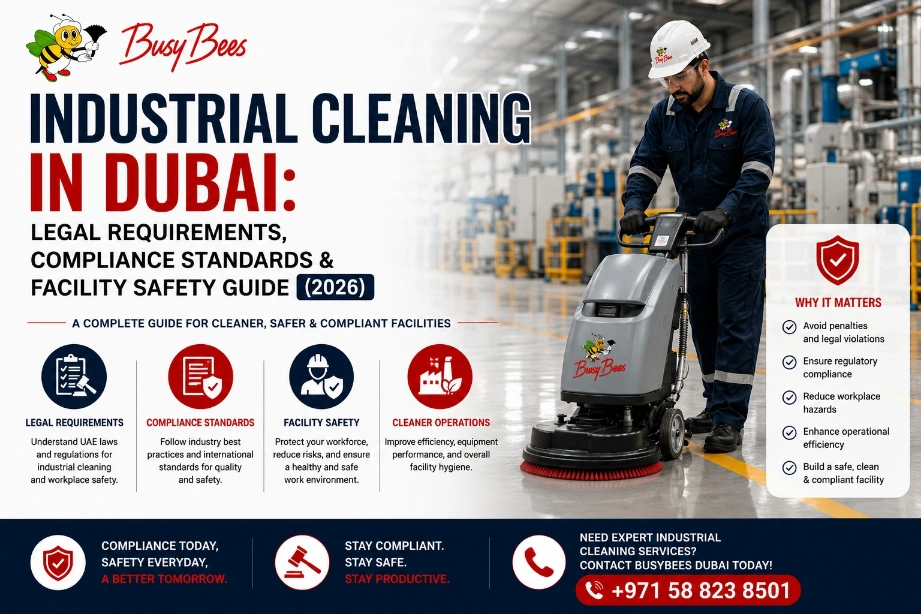
Gone are the days when facility hygiene for industrial settings was an internal business decision. In 2026, the law makes cleaning an essential component of facility management for industrial sites in Dubai. Strict municipal codes, public health mandates, and zero-tolerance labor laws make industrial cleaning a legal obligation rather than just a choice.
Factories, warehouses, and commercial facilities across industrial zones like Al Quoz, Jebel Ali, and Dubai Investment Park are now treating heavy industrial cleaning as a critical tool for maintaining order and safety on their premises. Failure to comply with deep sanitation protocols not only exposes your workers to serious health risks but can also lead to heavy municipal fines, temporary ban, and legal liability.
Dubai’s regulatory push for industrial cleaning aims to protect public health, maximize resource utility, and ensure worker safety. All types of industrial establishments across the city are subject to these regulations.
Why Industrial Cleaning in Dubai is Mandatory by Law
1. Indoor Air Quality and Law No. (5) of 2025
The legal perception around facility management changed completely with the full enforcement of Law No. (5) of 2025 Concerning Public Health in the Emirate of Dubai. Specifically, Article 33 enforces strict indoor air quality (IAQ) parameters, making routine HVAC and ventilation duct cleaning mandatory in commercial and industrial settings.
Industrial facilities are particularly prone to the accumulation of ambient dust, particulate matter, and volatile organic compounds (VOCs), making deep cleaning not a choice but an essential routine practice.
Dubai Municipality (DM) enforces strict air quality regulations for industrial facilities to mitigate the risk of Sick Building Syndrome (SBS). This involves regular Indoor Air Quality Testing to ensure healthy and compliant work environments.
Specifically, the buildings are required not to exceed the following limits over an 8-hour continuous operational window:
- Total Suspended Particulates (TSP): Must remain below 150 μg/m³
- Total Volatile Organic Compounds (TVOC): Capped strictly below 300 μg/m³
- Formaldehyde (HCHO): Must not exceed 0.08 ppm
- Carbon Dioxide (CO₂): Maintained below 1000 ppm
Dubai’s extremely hot climate and high humidity accelerate the accumulation of fine dust, mold, and allergens inside industrial HVAC ducting and complex machinery parts. Under Law No. (5) of 2025, facility managers must maintain a verified log of professional air quality testing and HVAC cleaning services.
Compliance failure can lead to serious and heavy penalties, ranging from commercial fines to temporary operational suspension and license revocations.
| Indoor Air Quality Parameter | Maximum Allowed Limit |
|---|---|
| Total Suspended Particulates (TSP) | Below 150 μg/m³ |
| Total Volatile Organic Compounds (TVOC) | Below 300 μg/m³ |
| Formaldehyde (HCHO) | Below 0.08 ppm |
| Carbon Dioxide (CO₂) | Below 1000 ppm |
2. UAE Labor Law for Industrial Sanitation
Worker safety in industrial environments is no longer restricted to hard hats and protective suits. UAE Labor Law (Federal Decree-Law No. 33 of 2021) mandates that employers provide a safe and hygienic working environment to protect employees from occupational accidents, diseases, and health risks.
In high-traffic industrial sites such as factories and chemical refineries, the accumulation of industrial grease, chemical waste, and dust requires routine professional cleaning to restore healthy work conditions.
If an industrial facility experiences localized outbreaks or a string of illnesses among staff with a root cause linked to cleaning or facility maintenance, it can lead to serious legal repercussions, including compulsory payouts to workers for medical treatments, temporary production shutdowns, and potential legal liability.
3. Law No. (18) of 2024 for Waste Management
How your facility manages industrial waste directly impacts cleanliness and hygiene. Law No. (18) of 2024 Concerning Waste Management in the Emirate of Dubai mandates strategic sorting of all industrial waste, byproducts, and cleaning residues.
Industrial activities, including cleaning, produce massive complex waste every year. This includes chemical residue, contaminated oils, degreaser solutions, and toxic sludge. Law No. (18) of 2024 defines regulations for the appropriate handling of this waste and preventing it from mixing with general municipal waste.
- Mandatory Segregation: Hazardous chemical waste must be stored and processed separately from general waste. Failure to do so can result in municipal fines up to AED 200,000.
- Digital Traceability: Any industrial waste or cleaning residue must be handled only by a Dubai Municipality-licensed contractor. Every batch must have a digital Waste Transfer Note (WTN) to track its progress.
4. The JAWDA Initiative: Elevating Supply Chain Standards
| Regulation | Main Requirement | Impact on Industrial Facilities |
|---|---|---|
| Law No. (5) of 2025 | Indoor Air Quality Compliance | Mandatory HVAC and duct cleaning |
| Federal Decree-Law No. 33 of 2021 | Worker Health & Safety | Hygienic workplace requirements |
| Law No. (18) of 2024 | Waste Management | Waste segregation and disposal compliance |
| JAWDA Framework | Facility Quality Standards | Better ratings and business opportunities |
While Dubai Municipality oversees the baseline compliance, the JAWDA Quality Improvement Framework defines the operational benchmark across local supply chains. JAWDA assigns a quality rating to facilities based on factors such as structural integrity, environmental safety, and facility optimization.
A high JAWDA quality rating can help logistics hubs, cold-storage warehouses, and manufacturing plants secure major commercial partnerships and boost market reputation. Facilities that fail to meet mandatory hygiene or cleanliness regulations often struggle to find good business partners.
Implementing rigorous, routine industrial deep-cleaning services is crucial to enhancing your facility’s JAWDA rating.
5. Paying Attention to Detail in Industrial Cleaning
Industrial systems are complex and dangerous. Trusting an in-house sweeping crew to clean a large facility is not just unwise but can pose serious safety risks. Regular janitors or general equipment cannot handle deeply embedded dirt and industrial contaminants.
A professional industrial cleaning service in Dubai focuses on specific high-risk zones across your facility:
High-Level Structures and Cable Trays
In large warehouses or factories, fine dust accumulates over time on high-level overhead structural frames, lighting fixtures, and cable trays. Airflow from fans or HVAC units causes these contaminants to fall into production zones, compromising manufacturing quality and integrity. Professional cleaning focuses on high-level areas as well as general surfaces.
Plant Machinery and Grease
Without routine cleaning, hydraulic fluid, grease, and carbon buildup accumulate continuously on manufacturing equipment, forming a heavy layer over time. This creates a fire hazard and causes machinery to work extra hard, reducing productivity and increasing operational costs. Professional equipment cleaning and degreasing restores performance and ensures compliance with Dubai municipal regulations.
Industrial Floor Decontamination
Concrete or cement floors in industrial facilities readily absorb oil and chemical spills, tire marks, and heavy stains throughout the day. Using standard mops cannot remove these stubborn contaminants. Meeting municipal safety and compliance standards requires deep scrubbing using approved, eco-friendly solutions and industrial-grade equipment.
| Industrial Area | Common Contaminants | Recommended Cleaning Method |
|---|---|---|
| HVAC Duct Systems | Dust, mold, allergens | Professional duct cleaning |
| High-Level Structures | Dust and airborne particles | Elevated access cleaning |
| Production Machinery | Grease, oil, carbon deposits | Industrial degreasing |
| Factory Floors | Oil spills, tire marks, chemicals | Deep scrubbing and pressure cleaning |
| Waste Storage Areas | Hazardous residues | Specialized sanitation and waste handling |
6. Building an Audit-Ready Compliance Framework
To protect workers’ well-being and minimize the risk of sudden regulatory actions, penalties, or business suspensions, facility managers must implement a periodic, documented deep cleaning system through licensed, trained cleaners utilizing approved cleaning products to keep facilities spotless and germ-free.
Maintain detailed records of all cleaning services, dates, chemicals used, cleaning team credentials, and booking details. This can come in handy during random inspections or audits.
Conclusion
Industrial cleaning in Dubai is no longer optional; it’s a legal requirement to ensure compliance with laws and protocols, including the JAWDA Initiative. The cost of a professional industrial cleaning service is often far less than the cost of suspension or severe penalties imposed for compliance failure. Partnering with an experienced company like BusyBees Dubai ensures your industrial facility is safe, efficient, and fully compliant with evolving facility management norms.

When the dust settles, BusyBees steps in. We are the #1 trusted post-construction cleaning services company in the UAE, helping Read more

Dubai’s iconic skyline and luxurious villas deserve crystal-clear windows and glass that reflect their persistent beauty. Whether it’s a commercial Read more

Dubai, one of the most famous cities in the world, is home to people from diverse cultures and backgrounds. Due Read more

Whether it’s your home or workplace, routine cleaning isn’t just about making your place look attractive—it’s about maintaining a hygienic, Read more
